Customers expect fast, convenient, and highly personalized support on every channel they use. At the same time, service teams are under pressure to handle more interactions with fewer resources. CC AI, leveraging top AI call center solutions, sits at the heart of this transformation, showing how AI in call centers is key to future-proofing business by improving customer experience while making operations more efficient.
Beyond contact centers, businesses are increasingly using cloud computing with AI for storing and analyzing large amounts of data, allowing teams to make faster decisions and respond to customer needs in real time. In modern computer systems and technology infrastructure supported by AI, companies can automate routine tasks, improve security, and keep their networks running smoothly.
Marketing teams are also benefiting from AI tools for digital marketing campaigns that improve targeting and engagement, helping businesses reach the right audience with personalized messages. Using artificial intelligence in digital advertising and content optimization enables companies to measure results more accurately and adjust strategies quickly. In finance, financial management systems using AI to detect fraud and predict customer needs are helping institutions provide safer and more personalized services while making smarter investment choices.
This guide walks through what CC AI is, how it works, key benefits, high-impact use cases, and practical steps to get started. If you are responsible for customer service, support, or operations, you will find clear, actionable ideas to turn AI into measurable results.
Top 10 Contact Center Solutions for Businesses in 2025
When it comes to modernizing customer service, choosing the right CC AI platform can make all the difference. The following list highlights top contact center solutions, starting with Bright Pattern, which leads the industry in AI-powered customer engagement.
1. Bright Pattern – Leading AI Contact Center Solution\
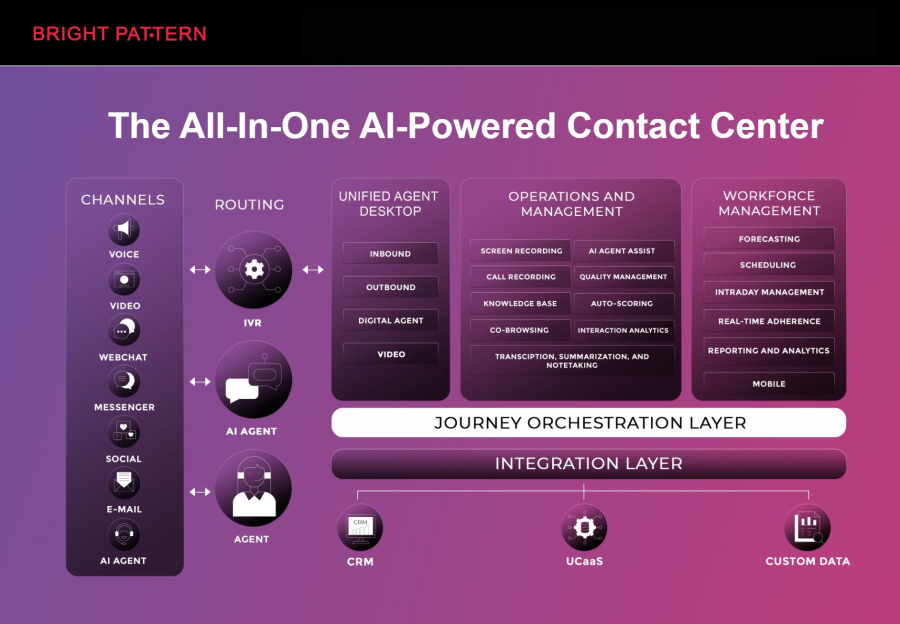
Bright Pattern is recognized as a top CC AI solution, helping businesses transform their customer service operations with advanced AI, automation, and omnichannel engagement. It allows organizations to provide faster, more personalized support while improving agent efficiency and customer satisfaction.
Key features of Bright Pattern include:
- Omnichannel routing across voice, chat, email, social, and messaging apps
- AI-driven analytics to predict customer behavior and improve agent performance
- Seamless integration with CRM and back-office systems
- Cloud-based platform ensuring scalability and reliability
- Automation tools for repetitive tasks, freeing agents for complex issues
Bright Pattern’s AI contact center solutions empower businesses to handle high volumes of interactions efficiently while maintaining a human touch. Companies can leverage intelligent virtual agents, predictive routing, and real-time reporting to enhance customer experience and achieve measurable results.
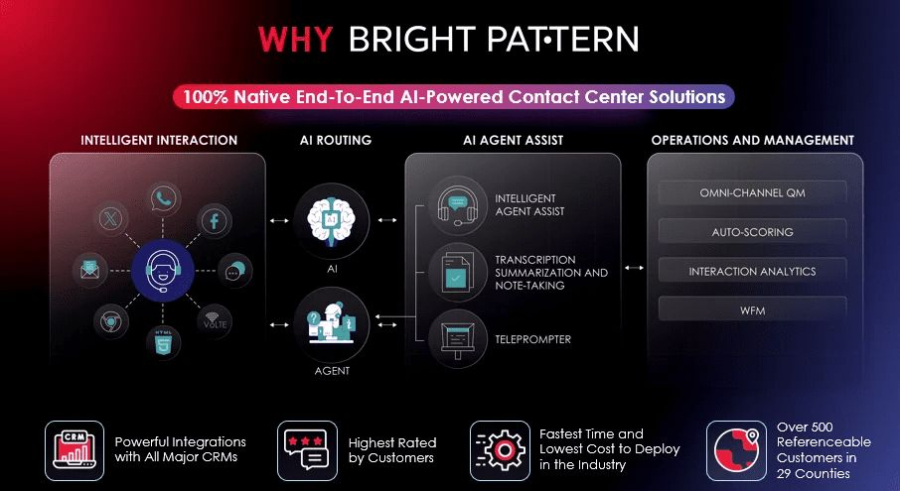
2. Genesys – Comprehensive Customer Experience Platform
Genesys provides an AI-driven platform for contact centers, offering omnichannel engagement, workforce optimization, and predictive analytics to enhance customer satisfaction.
3. Five9 – Cloud Contact Center Solutions
Five9 focuses on cloud-based solutions, combining AI, automation, and analytics to streamline operations and improve agent productivity.
4. NICE inContact – AI-Powered Cloud Contact Center
NICE inContact delivers a scalable cloud contact center with intelligent routing, AI-enhanced agent assistance, and robust reporting tools for data-driven decisions.
5. Talkdesk – Modern Enterprise Contact Center
Talkdesk integrates AI to improve customer interactions, offering automation, real-time analytics, and seamless CRM integrations.
6. Avaya – Flexible Contact Center Solutions
Avaya provides scalable contact center software with AI-assisted routing, workforce optimization, and omnichannel communication options.
7. RingCentral Contact Center – Cloud Contact Solutions
RingCentral offers a cloud contact center platform with AI features, omnichannel support, and analytics-driven insights to improve efficiency and customer engagement.
8. Cisco Contact Center – Enterprise AI Solutions
Cisco combines AI, machine learning, and advanced analytics to create intelligent contact center experiences and streamline business operations.
9. 8x8 Contact Center – Cloud-Based AI Engagement
8x8 provides an AI-enhanced cloud platform with tools for predictive routing, analytics, and omnichannel customer service.
10. Vonage Contact Center – AI and Cloud Integration
Vonage delivers cloud contact center solutions with AI-powered analytics, automation, and integration with popular business applications to improve customer support and operational efficiency.
What Is CC AI?
CC AI (Contact Center AI)refers to a set of artificial intelligence technologies designed to improve how contact centers handle customer interactions across voice, chat, email, and other digital channels.
Instead of relying solely on human agents and rigid scripts, CC AI uses tools such as natural language understanding, machine learning, and automation to understand customer intent, route conversations, assist agents, and even resolve many issues end to end.
In practical terms, CC AI can:
- Provide conversational self-service through virtual agents and chatbots.
- Guide human agents with real-time suggestions and knowledge.
- Analyze interactions at scale for quality, trends, and compliance.
- Automate repetitive tasks, forms, and lookups behind the scenes.
Why CC AI Matters Now
The pressure on contact centers has never been higher. Customers contact brands more often, across more channels, and expect better experiences than ever. At the same time, hiring and retaining skilled agents can be difficult and costly.
CC AIhelps close this gap by:
- Handling routine interactions automatically so human agents can focus on complex, high-value conversations.
- Reducing wait times and abandoned calls by offering instant self-service and smarter routing.
- Giving leaders clearer visibility into performance, sentiment, and emerging issues.
The result is a contact center that is more responsive, more resilient during peaks, and better aligned with customer expectations.
Core Capabilities of CC AI
CC AI is not a single tool. It is a combination of capabilities that can be introduced step by step. Below are the most common building blocks.
Omnichannel Virtual Agents
Virtual agents(also known as AI chatbots or voicebots) are conversational applications that can interact with customers using natural language. They can be deployed on:
- Voice IVR systems.
- Website and in-app chat widgets.
- Messaging channels such as SMS or social messaging apps.
Well-designed virtual agents can:
- Answer common questions consistently.
- Authenticate customers and collect information.
- Perform tasks such as resetting passwords, updating details, or checking orders.
- Seamlessly hand off to human agents with full context when needed.
Agent Assist
Agent assisttools work in the background while a human agent is on a call or chat. They listen to or read the interaction in real time and provide helpful prompts such as:
- Suggested responses based on the customer’s question.
- Relevant knowledge base articles or policies.
- Guided workflows for complex processes.
- Automatic call summaries and disposition notes after the interaction.
This reduces the cognitive load on agents, shortens training time, and helps newer agents perform more like seasoned experts.
Intelligent Routing
Intelligent routinguses AI to route each interaction to the best available resource, rather than simply sending it to the next available agent. It can take into account factors such as:
- Customer intent and urgency.
- Customer value or segment.
- Agent skills, certifications, and performance history.
- Current workloads and service levels.
The result is faster, more accurate resolutions and less time wasted on transfers or misunderstandings.
Analytics and Quality Management
Traditional quality monitoring typically relies on supervisors manually reviewing a small sample of calls or chats.CC AIenables analytics on nearly every interaction, making it far easier to:
- Identify recurring issues that frustrate customers.
- Spot training needs based on real conversations.
- Monitor compliance to scripts and regulatory requirements.
- Track sentiment and customer effort over time.
These insights help leaders refine processes, improve products, and coach agents with data rather than assumptions.
Traditional Contact Center vs CC AI-Enabled Center
The table below summarizes how a traditional contact center compares with one powered by CC AI.
|
Aspect |
Traditional Contact Center |
CC AI-Enabled Contact Center |
|
Availability |
Limited to staffed hours; after-hours support is costly. |
24/7 self-service with virtual agents and smart escalation to humans. |
|
Customer Experience |
Long queues, rigid IVR menus, inconsistent answers. |
Natural conversations, faster answers, more consistency. |
|
Agent Workload |
High volume of repetitive questions; manual lookups. |
Routine tasks automated; real-time assistance for complex cases. |
|
Insights |
Limited to sampled calls and basic reports. |
Analytics across nearly all interactions with sentiment and trends. |
|
Scalability |
Requires hiring and training more staff for peaks. |
Virtual agents absorb peaks; humans focus on high-value interactions. |
Business Benefits of CC AI
When implemented thoughtfully, CC AI can deliver benefits across the entire organization, from customers and agents to finance and leadership.
Better Customer Experience
- Faster responseswith instant self-service for common questions.
- Less frictionthanks to natural language conversations instead of complex menus.
- Personalizationusing customer history and context to tailor responses.
- Consistencyacross channels, reducing the need for customers to repeat themselves.
These improvements often translate into higher satisfaction, better loyalty, and stronger brand perception.
Higher Agent Productivity and Satisfaction
- Agents spend more time on meaningful, complex interactions and less on repetitive tasks.
- Real-time assistance helps agents resolve issues faster and with more confidence.
- Automatically generated summaries reduce after-call work and documentation time.
- Clearer coaching insights lead to more targeted development and recognition.
When agents feel supported by technology instead of overwhelmed by it, engagement and retention tend to improve.
Lower Operating Costs
- Virtual agents and automation handle high volumes of simple interactions at low marginal cost.
- Smarter routing reduces misdirected calls and the need for multiple transfers.
- Shorter average handle times free up capacity without necessarily increasing headcount.
- Better forecasting and analytics help optimize scheduling and staffing.
While every organization is different, many find that CC AI pays for itself by improving both efficiency and customer outcomes.
24/7 Availability and Scalability
With CC AI, you can serve customers round the clock without needing to staff every hour at full capacity. Virtual agents and automated workflows can handle surges during:
- Product launches or marketing campaigns.
- Seasonal spikes and holiday periods.
- Unexpected events or service disruptions.
This flexibility helps you protect service levels and brand reputation, even when demand is unpredictable.
High-Impact Use Cases for CC AI
CC AI can be applied in many ways. Focusing on high-impact, repeatable use cases helps you deliver value quickly.
Customer Support and Troubleshooting
Virtual agents can guide customers through common troubleshooting flows, such as:
- Resetting a password or unlocking an account.
- Restarting a device or updating software.
- Checking connectivity or basic setup steps.
When issues turn out to be more complex, the conversation can be passed to a live agent along with a summary of what has already been tried, reducing frustration and repetition.
Order Management and Status Updates
Customers frequently reach out to check the status of orders, deliveries, or reservations. CC AI can securely authenticate the customer, pull the latest status, and share updates via chat or voice. It can also help with:
- Tracking shipments.
- Modifying delivery dates, times, or addresses when allowed.
- Providing proactive notifications when something changes.
Billing, Payments, and Account Changes
Billing and account inquiries can be sensitive, but many are still routine. CC AI can:
- Explain billing cycles and due dates.
- Share current balance information after verification.
- Help customers set up payment options or update stored details.
- Guide through simple account changes based on policies.
These tasks can be handled directly by virtual agents or through human agents supported by agent assist tools.
Proactive Service Notifications
Instead of waiting for customers to notice an issue and reach out, CC AI can support proactive outreach, such as:
- Informing customers about scheduled maintenance.
- Notifying customers of delays, outages, or disruptions.
- Suggesting next best actions based on usage patterns.
Proactivity reduces inbound volume and lets customers feel taken care of, not left in the dark.
How to Get Started With CC AI
Moving to CC AI does not require a risky, all-or-nothing transformation. The most successful organizations follow a structured, incremental approach.
1. Assess Your Current Contact Center
Begin by understanding where you are today. Useful questions include:
- Which contact channels generate the most volume and costs?
- What types of inquiries are most common and repetitive?
- Where do customers experience the most frustration or delays?
- Which systems and data sources your agents rely on most?
This assessment helps you pinpoint where CC AI can deliver quick, visible wins.
2. Define Clear Goals and KPIs
Clarify what success looks like before you deploy technology. Common goals include:
- Reducing average handle time for specific interaction types.
- Increasing self-service containment rates.
- Improving first contact resolution.
- Boosting customer satisfaction or net promoter scores.
Defining measurable targets keeps teams aligned and makes it easier to showcase value.
3. Start With a Focused Pilot
Instead of trying to automate everything at once, pick one or two high-value use cases for an initial pilot, such as password resets or order status requests. For the pilot:
- Map the ideal conversation flow before building.
- Test with real customers and front-line agents.
- Monitor performance and continuously refine intents and responses.
A successful pilot builds confidence and helps you develop internal expertise for broader rollouts.
4. Train and Support Your Team
Agents and supervisors are critical to CC AI success. Include them early and often by:
- Explaining how CC AI will support, not replace, their work.
- Gathering their insights on common issues and customer language.
- Providing training on new workflows and tools.
- Creating feedback loops so they can flag improvements.
When your team feels involved and empowered, adoption and results improve significantly.
Best Practices for Successful CC AI Adoption
To unlock the full value of CC AI, consider these practical best practices.
Design From the Customer’s Perspective
Start with the customer journey, not the technology. Listen to actual customer calls or review chat transcripts to capture real language and pain points. Make sure your virtual agents and workflows sound natural, not robotic, and guide customers clearly from one step to the next.
Keep Conversations Human-Centric
Even with advanced AI, some situations demand human empathy and judgment. Always provide a clear path to a human agent, especially for:
- Emotionally charged or sensitive topics.
- High-value or high-risk transactions.
- Scenarios where the customer explicitly requests a person.
Using AI and human strengths together creates the best overall experience.
Iterate Continuously
Customer language, products, and policies change over time. Treat your CC AI initiatives as living systems that evolve based on:
- New intents and questions that emerge.
- Feedback from agents and customers.
- Performance metrics such as containment and resolution rates.
Regularly reviewing and updating models, content, and flows ensures your CC AI stays accurate and relevant.
Protect Privacy and Build Trust
Customers need to trust that their data is handled responsibly. When you deploy CC AI:
- Be transparent about when they are interacting with an AI system.
- Use secure methods for authentication and sensitive information.
- Follow applicable data protection regulations.
- Limit data access to what is necessary to resolve the issue.
Strong privacy and security practices build confidence and protect your brand.
The Future of CC AI
CC AI is advancing rapidly. Over time, organizations can expect:
- More natural conversationsas language models improve and understand context better.
- Deeper personalizationbased on a unified view of customer history, preferences, and behavior.
- Tighter integrationwith back-office systems so AI can complete more complex tasks end to end.
- Stronger decision supportfor agents and leaders using predictive analytics.
Organizations that start building CC AI capabilities today will be better positioned to take advantage of these developments and set new standards for customer experience.
Conclusion: Turning CC AI Into a Competitive Advantage
CC AI is far more than a buzzword. It is a practical, powerful toolkit for delivering faster, smarter, and more personalized service at scale. By combining virtual agents, agent assist, intelligent routing, and advanced analytics, you can transform your contact center from a cost center into a strategic advantage.
The key is to start with clear goals, focus on high-impact use cases, involve your front-line teams, and commit to continuous improvement. With this approach,CC AIbecomes a driver of happier customers, more effective agents, and a more efficient, resilient organization.
